Over the past few years, digital financial inclusion efforts have focused heavily on expanding access and improving infrastructure. More people have bank accounts. More people have mobile devices. More services are available digitally.
But access does not always translate into successful use.
In my research on mobile banking in Nigeria, I repeatedly observed something difficult to ignore: users who had access, basic digital skills, and a clear goal still struggled to complete simple tasks.
This work was invited for presentation at UNU-EGOV and nominated for Best Research Paper at ICEGOV2025.
The way we frame inclusion creates an invisible group of users
This gap is not accidental. It reflects how digital inclusion is currently framed at a policy level.
Frameworks such as the National Digital Literacy Framework (NDLF), the Digital Literacy Global Framework (DLGF), and regulatory approaches like the Central Bank of Nigeria’s guidelines for mobile financial services place strong emphasis on access, skills development, and adoption.
These are critical. But they are built on an underlying assumption: that once users have access and skills, successful usage will follow.
In practice, this creates an overlooked group of users: those who are neither fully excluded nor fully included. They have access to digital services, some level of digital familiarity, and the intention to use these systems. But they are unable to complete key tasks independently.
They sit in between. And because they do not fit neatly into categories of “excluded” or “literate,” they are often invisible in both policy and measurement.
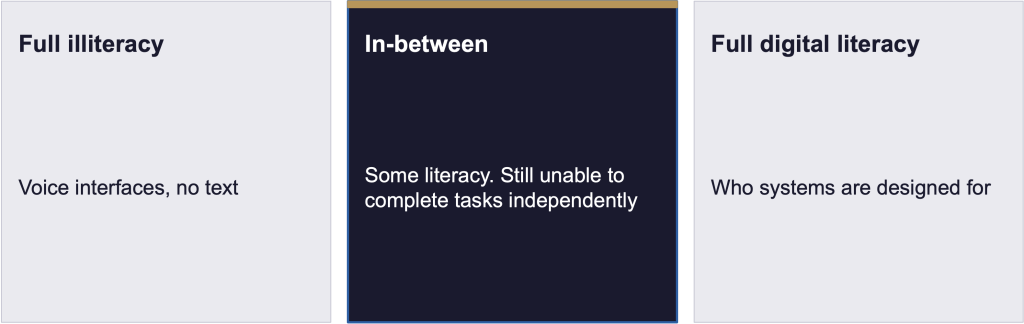
This group is not marginal. It represents a significant portion of users who are counted as included in access and adoption metrics, but who cannot reliably complete tasks independently. As a result, the scale of the problem is often underestimated. Not because it is rare, but because it is not being measured
Users with access and skills still cannot complete basic tasks
What this overlooks is what happens to these users at the point of interaction.
Through usability studies with mobile banking users in Nigeria, several patterns emerged: users got stuck during transfers and form completion, multi-step processes created confusion and hesitation, error messages were unclear or unhelpful, and confirmation flows disrupted understanding rather than supporting it.
These were not edge cases. They were consistent, observable breakdowns. Importantly, they occurred even when users had already been onboarded, trained, or had prior exposure to digital systems.
One finding stood out. The majority of participants had previously completed equivalent financial tasks (money transfers, airtime purchases) using USSD. They understood what they were trying to do. But when faced with a mobile banking application, they could not complete the same tasks independently.
The problem was not capability.
The problem was not familiarity with the task.
It was how the task was structured at the interface level.
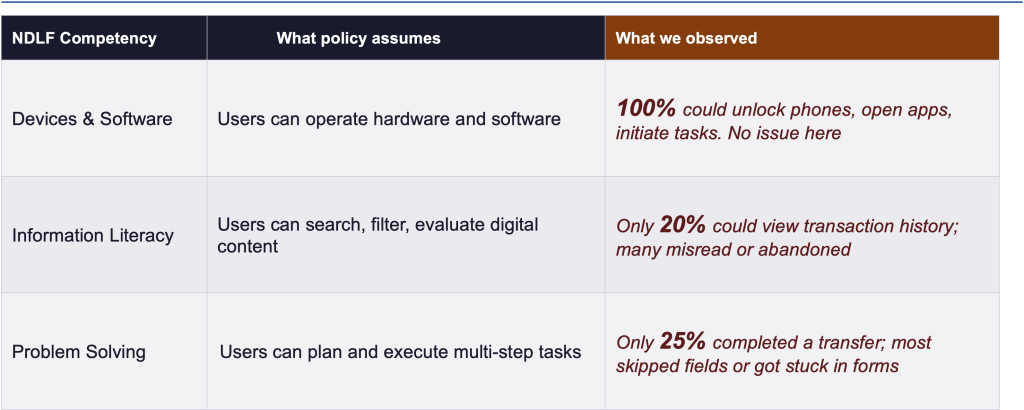
The gap becomes more visible when lived experience is compared with policy assumptions
Looking at usability evidence alone shows where users struggle.
Looking at policy frameworks alone shows how inclusion is defined.
But it is only when the two are considered together that the gap becomes visible: not just as a design issue, but as a mismatch between how inclusion is assumed to work and how it actually unfolds in practice.
Training does not translate into independent task completion
This raises an important question about current approaches to digital inclusion: if users are trained, but still cannot complete tasks independently, what exactly is being transferred?
Much of the current emphasis on digital literacy assumes that skills can compensate for system complexity. But in practice, users often rely on memorisation of steps, repeated assistance, and trial-and-error navigation. This does not lead to transferable capability. It leads to fragile usage that breaks as soon as the interface changes, the flow shifts, or the context varies.
This points to what might be called a competency trap: the persistent assumption that better-trained users can overcome poorly designed systems.
Training systems are being built on top of frameworks that do not account for how interfaces actually work. The result is that users are being prepared for systems that were never designed with them in mind.
The issue is not just user capability, it is system design
At this point, the issue is no longer just about user capability. It becomes a question of system responsibility.
Current policy frameworks rarely account for whether users can complete critical tasks independently, where interaction breakdowns occur, or how interface design shapes real-world outcomes. As a result, exclusion at the interface level remains largely unmeasured and unregulated.
More importantly, there is rarely a clear requirement for any actor in the system to assess whether users can actually complete tasks at the point of interaction. As a result, this layer sits outside formal accountability, even though it is where inclusion ultimately succeeds or fails.
This matters because interaction barriers make inclusion surface-level, not functional
When interaction barriers persist, inclusion becomes surface-level rather than functional. Users depend on agents, introducing cost and risk. System metrics can overestimate success. And the gap between policy intent and lived experience widens.
For organisations focused on translating access into real-world outcomes, this points to a measurement gap worth taking seriously. Task completion at the interface level is observable and measurable. It can reveal where participation breaks down, for whom, and why, in ways that access and enrolment data alone cannot.
If the goal is outcomes, then we need to shift how we think about inclusion
Digital inclusion does not only fail at the level of access or skills.
It often fails at the point of interaction, where policy expectations meet real user behaviour.
If the goal is to move from access to outcomes, then the interaction layer cannot remain invisible.
Because inclusion does not fail in theory.
It fails in use.
Further Context
- I presented this work at a UNU-EGOV webinar.
- Full ICEGOV2025 research paper available on request.
- Watch the video of the recording: available here
- Download the slides: available below